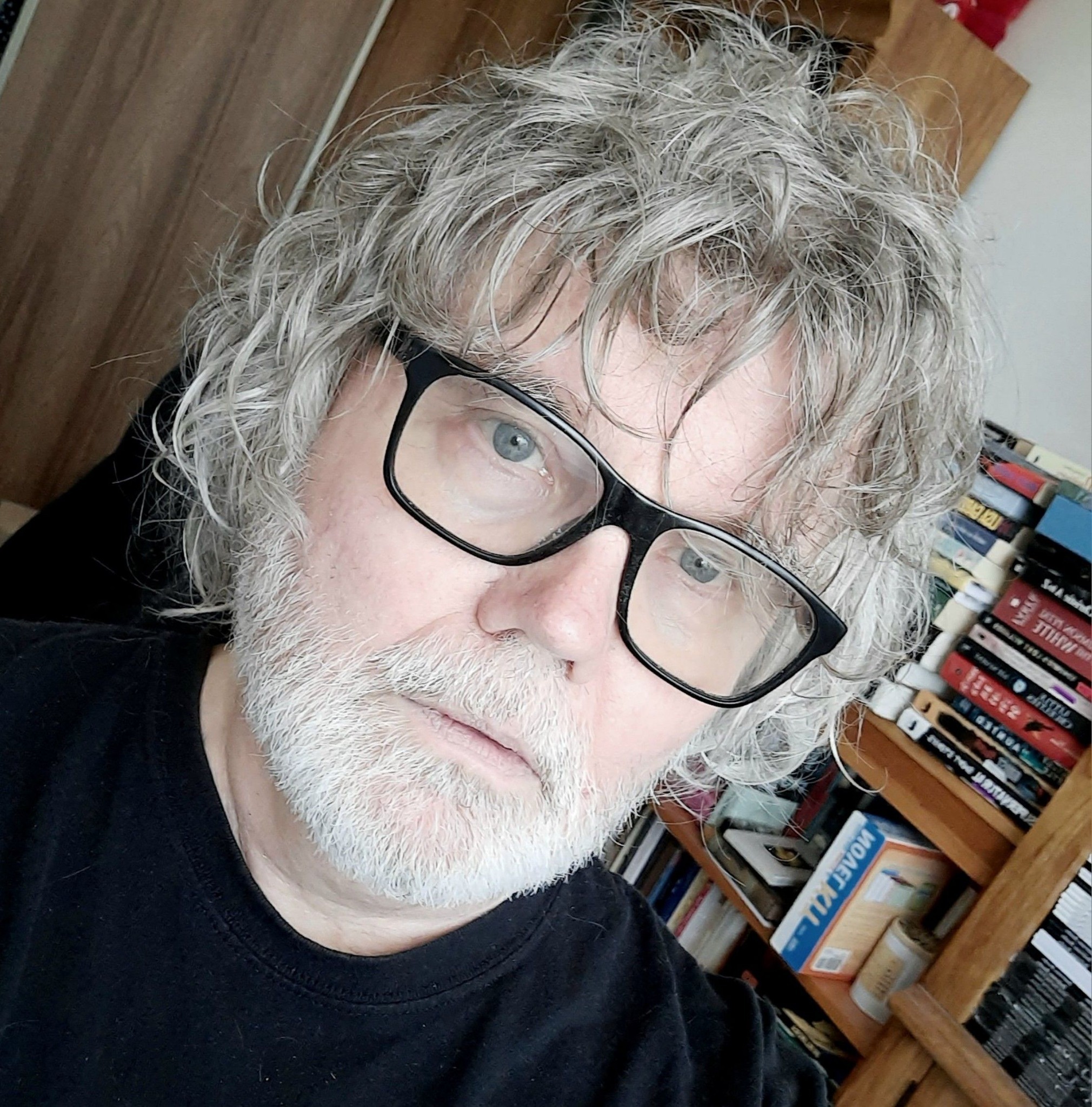
all poems ©2026 Andreas Gripp
The Blade
Those who take up the sword
shall perish by the sword.
—Matthew 26:52
Sword must be the mightiest
word in the world. See it for
yourself: word is already contained,
its double-
daggered w
left unsaid, mistaken
for a pair of muted v—
fleet-footed samurai
set to slice;
on tiptoes like the shrouded
a in stealth.
It’s the hero’s
weapon of choice—
unsheathed in half-a-second—
the honour that it brings, a rod
for Thorian bolts, epitome
of Herculean effort.
Conan was its servant
not its master. Nothing else
can knight you on the shoulders.
Not an AK-47.
Not the atom bomb.
And surely not a Molotov—
its bearer fleeing the battle
once it’s tossed.
It’s the poster boy for
knives; something they aspire to
whenever their drawer is pulled.
It will help you in a pinch;
cut that brick of butter
that’s been sitting in the
fridge since olden days.
Silverware have winced
from golden auras—a smooth,
deceptive texture;
feigning they’re too spotty
to do the trick.
The sword itself
can never be surrender’s cause.
It knows no cowardice.
When it’s thrown onto the
ground in acquiescence,
it repudiates the fingers
which concede, always unforgiving;
vengeful to the bone.
It does more than
simply wound. It severs the
brain from body. The body
from the soul. Takes our proud
identity away.
It’s just in its show
of mercy. Merciless
when it’s just. It will invade
and/or defend. It even serves to
splice the conjugations.
Unyielding Excalibur.
Few are worthy to wield.
It’s our past and it’s our
future. Willing to adapt
if it must. Alight in the
hands of Kenobi. Aflame
with Joan of Arc.
Forged when war arrives
& it always will.
The sword can take a punch—
pounded on an anvil
in a blaze, till it blinds us
like the sun. Its deafening,
immutable roar, as though a
mother giving birth
in archaic times.
We are all its sons.
We are all its daughters.
It’s twin-edged for a reason,
honed in its locution.
Its language is its
glory. It harbours the gift of
tongues. We know exactly
what it says when
it disrobes, recoiling from
its naked retribution.
The Burden


You were five
when you had spelled
your family name—aloft
with crow & owl—

Fisher & Son,

and you without
a brother, though you’d wait
for years for one, hoping
he’d take the pressure
off your shoulders,
like Simon of Cyrene
the cross of Christ;

and it surely wouldn’t
have been as bad as that:
beatings till you swelled,
thorns inside your toque,
a hammer thumping nails
into your wrists and not the
barn.

Instead of evening chores,
you lay upon the straw as if
a manger—
the Saviour for his farm,
encircled by geese & goats,
the lilt from a fatted calf—
not a lamb that is fated
for the slaughter—

but a heifer
which is milked unto the
bone, fenced on every side,
fettered in a maze of soaring
corn;

looking to a moon you’ll never
visit—foregoing astronaut,
your dream of engineer,
unable to sing of its glow
to the girl of your choice—
or boy if you prefer
and I think you do—

asking if he’ll kiss you
on the cheek,
bleeding from your
brow you’ll say is sweat
from a hard day’s work.
For Such is the Kingdom


There are only so many
ways you can pen of
innocence. Do it with a quill
and you’re precluded.
For who has conferred
the right—to write with another’s soul?

How do you know
the gull won’t circle
back, scan the grit of sand
for what is theirs?
And why assume a circle?
There are twenty
trillion shapes from which to
choose. Every Magen David—trigons
that wouldn’t stay put.

Why do we
bleed out and never in?
Ink has the viscosity
of life.

I  have never seen
the blood of birds.
Maybe it has lingered in Aquila.
Or is the colour of
our air. I was told
that I could spot it if
my orbs & palms were clenched;
focused like The Thinker
of Rodin. He would have
found his answer—

had he raised
his gaze to Sol—stumbling with every
step is but a trifling sum to pay.

Water’s not as limpid
as we thought.
Cup it in your
hands before you drink. See
what’s never seen. Faith is
so much certitude
you explode.

Flowers unfurl like
sails whenever a
zephyr clears its throat.

The hidden
know we’re watching.
That’s why those who  haven’t  vision
are selected. Bartimaeus
in the shadow
of the Christ.

I only spy your sigh
when it is freezing. When a
surface is so thick
you cannot drown.

You alight a mourning
candle just to blow it out
again. There’s a sacred
kind of sight that it
bestows—

when only one
of your pupils swells,
allowing a riddle
to pass.

This was to be a poem
about the children. Stretching
out their arms to touch
the Lord. Or deliver their
breath to the wind—
the mother of our flight.
Even when it’s still
it’s always there. Wings are merely
hands which fail to doubt;
a kite in stagnant sky
that skiffs its sea.
Evanescing clouds
which scale the
blind eye of the sun.
Juxtapositions


I pluck the olives from the
salad and that makes it less than
Greek. You ask me if they’re green
or black and I state
it makes no difference.

I replace the blocks of feta
and consider German-Jew.
It’s been an awful oxymoron
since nineteen-thirty-three.
I’ll blend some smoky Rauchkäse
with an agѐd Gvina Levana—

swap my cricket cap
for a yamaka
just in case you take offense.

Now bring me beer from Bavaria
and hot latkes from the slum.
I’ll gladly prove

what cannot go together
is just a fallacy of
thought:

A frown is a smile
that’s standing on its head.

Feet are a pair of hands
which are unwilling to clasp
in prayer.

Toes are very cognisant
that fingers are more graceful—
so they never stretch for sky.

Unable to grant any light
of its own, the moon is but a
mirror for the sun—
in which to worship its
own reflection
(and we thought that Dorian Gray
was the one who’s really vain).

What is ugly, anyway?
Is it the absence of beauty
or too much of it all at once?
The Phobia, or Channeling Orville
Redenbacher—with cheese


Willard, there are rats in the basement
—1971

Ben, most people would turn you away
I don’t listen to a word they say
They don’t know you as I do
—Michael Jackson

There is no fear in love
—1 John 4:18

Mice are always
cuter out-of-doors.
The way they squeak
& squirm has always
given me the willies.

Why I’m watching Willard
I do not know. But Ben &
friends have shown me that
these rats would be much worse.
They’ll chew you to the marrow—
your wires in the wall as though
it’s licorice.
Ditto for the Wiley Wallaby
in your engine—
your Mustang ’72.

They’re piranhas
who’ve learned to crawl, claws
in place of fins. Unlike squirrels

they’ve absconded our endearment;
eschewed a fuzz-on-tails
which may have saved.

Teach me about the
line of love & hate.
Narrow like a whisker.
The space
between each tooth.

Love is a bath of water for
the birds. Leaving it in the
night since it’s the bats
who lap it up. Their wings
like fallen angels, the flip-
side of the finch. A rat in
hellish flight.

But maybe it’s the sky
who knows them best.
It’s why we lift
our visage to the stars.
Why we think of heaven
in the plumes. You surely
didn’t think it
out of fright?

Not theirs—mine when I hear a
scratching in the gypsum,
never considering a drywall’s
simple itch, or the ghosts are
now so lonely they’ll
speak in the only
wretched language they have left.
Nine

There’s a beauty to our numbers
that I note with admiration:

the shape of cipher 6
and its curving, crescent close;

8, with its weaving, double loop
that skaters strive and scratch to mimic;

3, and its ability to complete,
to divide as trilogy, to manifest
as Trinity;

1 which finds the wholeness
in itself, never wishing to flee
its core or essence,
for the sake of multiplying:

One times one times one
will always equal one.

2 is the sum of love,
the most romantic of all our digits,
and in terms of teaching math,
it gives a break to all our children:

Two times two is four,
and the answer’s the same
when adding.

7 is Biblical,
the week for God’s creation,
the length of telling tales
of Harry Potter, of Narnia,
the complement of 12.

5, the Books of Moses,
the fingers and thumb
on our hands,
giving us ability,
the gift of grasp
and molding, making shapes
from slabs of clay.

4, a pair of couplets,
the voice of poems
and song, the rhythm
and march of the saints.

Yet when I come to number 9,
my spirit starts to sink:

it has such lofty expectations,
aspiring to reach new levels,
only to fall so painfully short—

missing the mark of 10
by just a meagre, single stroke;
always being known for
“almost there,”
remembered for the glory
it could have gained
but never got,
its cousins—19, 49, 69—
bearing the brunt
of all its failings.

99 is but a stepping stone,
a grating lapse towards 100,
a number we only watch while it rolls,
a humble countdown to celebration,
unable to give us merit on its own.

I spent all of ’99
yearning for 2000,
anticipating a new millennium,

the fears, excitement
we thought awaited us
in a dawning, changing world;
never enjoying the year for what it was,
practicing the writing
of an exotic date—

January 1, 2000

and eager to see
the masthead of that early morning paper,

ridding myself of the nines
that only accentuate defeat,

thinking I’ll pass some kind of threshold,
a singing, flowered archway
bidding come, enter,
leave what troubles you
behind.
The First Time

There’s a moment
when you’re grieving
you forget.

It’s the quarter-
second glint

when you peek up at
the solstice; your first
banana sundae
since it happened. The
stain that’s on your T-
shirt once you’re home—
it hadn’t been washed
since …

You’ll catch
yourself in chuckles
from the sitcom in her
cache—
this isn’t the time for Netflix—
that pang of guilt
that judges with its wig:
how dare you play
at happy.

The first time you’ll
awake it’s
slipped your mind—
albeit for a splinter of
a breath. Today we’re—

The first dream’s worst of
all. Your belovѐd
lives & waits
upon a bench
down by the brook. The
apogee of hair still
there. Every wing of
bird is lingering
with her. You have to recall the
one that is her namesake:

the lark we christened Barbra.

You remember she dropped the
e—between the 2nd
b & r. It never makes a sound
so what’s the point?

What you
can’t elicit—even by a
welling in the iris—
is how it takes to heaven—

the instant twigs
beneath your shoe are
cracked in two.

This is a poem of bones
and not of beauty.
How brittle they become
once the marrow’s
been usurped. A snap
that’s not forsaken
despite the volume set
to max on her favourite
song. You put one foot past
the other but not in
dance. For how can you
think to frolic? You’re
only wiping dishes—the plate on
which she slurped her
final crumbs, while you stood
amid the gloam & feigned a smile.
Smut

—a small flake of soot or other dirt
Oxford English Dictionary

To say my brand-
new book of poems is
just a magnet for the
dust

is an egregious
understatement.

It’s the maid
in fishnet stockings, feathers
in her hand, bending
with a twerk,
whenever I enter the
office.

It’s the Swiffer
that’s ascending to the
ceiling (comprised of
teasing glass)—
dander thudding
upon its clarity
like a dove.

It’s the Dirt
Devil
drafted into service—
like the cavalry
on horseback,
fire from its nostrils,
its tail of red
that’s locked into
the socket, coiled
like a serpent,
because nothing else
can gather up the
mites, their hunger
never chuffed.

If they stopped to view
my scribbles they might be
fans, foregoing their all-
day breakfast

just to read my absurdity—
like this, for instance,

where they line
up on the shelf
like an ellipsis
that is endless, half a trillion
strong , little pens and
paper in their hands, awaiting
my autograph—

and one who lifts her
skirt, imploring me to
sign her naughty thigh.
 Andreas Gripp